
The integumentary system consists of the skin, hair, nails, sweat glands, and sebaceous glands. It’s the body’s first line of defense, and it quietly regulates several homeostasis processes at once.
Major Functions
- Protection from physical damage and microbial invasion
- Prevention of water loss, through keratinization
- Sensory detection — touch, temperature, pain
- Thermoregulation, via sweating and blood vessel control
- Vitamin D₃ synthesis, triggered by UV exposure
Layers of the Skin
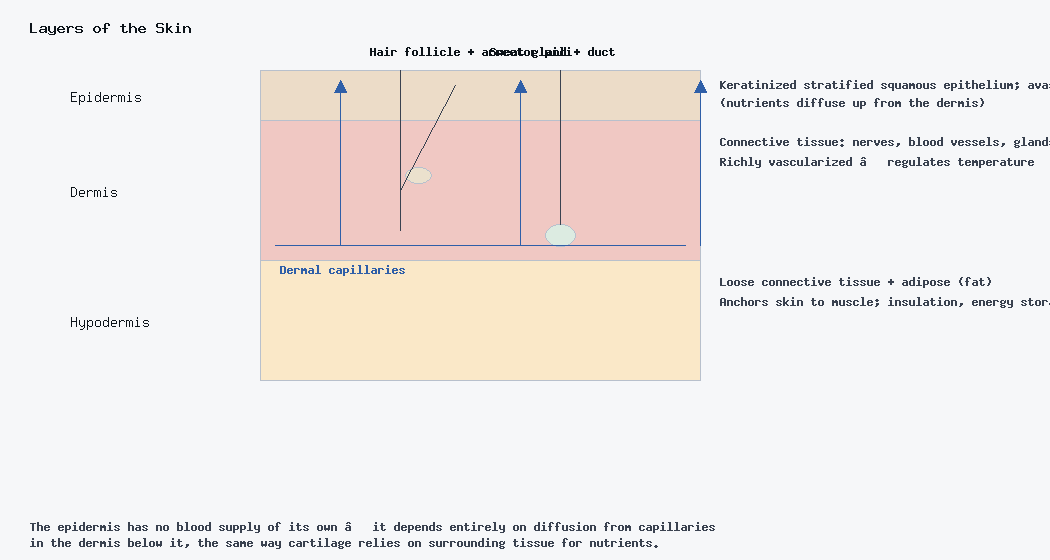
Epidermis — the outer, avascular layer, made of keratinized stratified squamous epithelium (essentially dead skin cells bound together by the protein keratin). Because it has no blood vessels of its own, nutrients have to diffuse up from the dermis — the same dependency cartilage has on surrounding tissue.
Dermis — the connective tissue layer beneath the epidermis. It provides strength and flexibility, and houses the nerves, blood vessels, and glands.
Hypodermis (subcutaneous layer) — loose connective tissue and adipose (fat) tissue. It anchors skin to the muscle underneath and doubles as insulation and energy storage.
Blood Supply
The epidermis is avascular; it gets nutrients and oxygen purely by diffusion from the dermis. The dermis is richly vascularized and is what actually supplies nutrients and regulates temperature. Worth remembering for exams: the blood vessels that ultimately supply the epidermis run through connective tissue in the dermis — they never enter the epidermis itself.
Accessory Structures
- Hair — grows from follicles rooted in the dermis.
- Arrector pili muscle — a small smooth muscle attached to the hair follicle; contracts in cold or emotional states, producing goosebumps.
- Sebaceous glands — secrete sebum, an oily substance that lubricates skin and hair.
- Merocrine (eccrine) sweat glands — produce a watery secretion for thermoregulation.
- Apocrine sweat glands — found in the armpits and groin, activated at puberty, and responsible for body odor.
Functions of the Skin
- Protection — guards against dehydration, injury, and microbial invasion.
- Thermoregulation — sweat cools the body as it evaporates.
- Sensation — receptors detect touch, pain, pressure, and temperature.
- Vitamin D₃ synthesis — UV radiation converts a cholesterol precursor into cholecalciferol, which is later converted to calcitriol to help absorb calcium.
- Excretion — sweat removes salts, water, and waste products.
Pigmentation and Skin Color
Melanin is a brown-black pigment made by melanocytes that provides UV protection — more UV exposure triggers more melanin production, which is what causes a suntan. Hemoglobin, the oxygen-carrying pigment in blood, gives light skin its pinkish hue.
- Cyanosis — a blue tint from deoxygenated blood, seen in conditions like a heart attack.
- Pallor — paleness from decreased blood flow.
Burns and Injuries
- First-degree burn — epidermis only; redness and mild pain.
- Second-degree burn — epidermis plus part of the dermis; blisters and severe pain.
- Third-degree burn — full-thickness, destroying both epidermis and dermis; painless, because the nerve endings themselves are destroyed.
Common exam trap: “if a burn is very painful, it’s likely third-degree” is false — it’s actually the opposite. A third-degree burn is painless because the nerves that would register pain are gone.
Temperature Regulation (Negative Feedback Loop)
- Stimulus — a change in body temperature, up or down.
- Receptor — thermoreceptors in the skin and hypothalamus.
- Control center — the hypothalamus.
- Effectors — sweat glands, dermal blood vessels, and skeletal muscles (shivering).
- Response — body temperature is brought back toward normal.
This is a textbook negative feedback loop — the response works to cancel out the original stimulus, which is exactly what keeps body temperature stable within such a narrow range.