
Bone is a living, supportive connective tissue — constantly being built up and broken down by a small cast of specialized cells, and tightly regulated by hormones to keep blood calcium levels stable.
Bone Composition
Compact bone is built from osteon structures, which house the blood vessels and nerves running through the bone matrix. Spongy bone is made of a lattice of trabeculae, which is what gives bone its lighter weight without sacrificing much strength.
Bone Matrix
- Calcium and phosphate — provide hardness and rigidity.
- Protein and collagen fibers — provide flexibility and the ability to stretch.
Both components matter: a bone matrix with plenty of minerals but no collagen is hard but brittle, while one with collagen but insufficient mineral is flexible but too soft to support weight.
Bone Cells
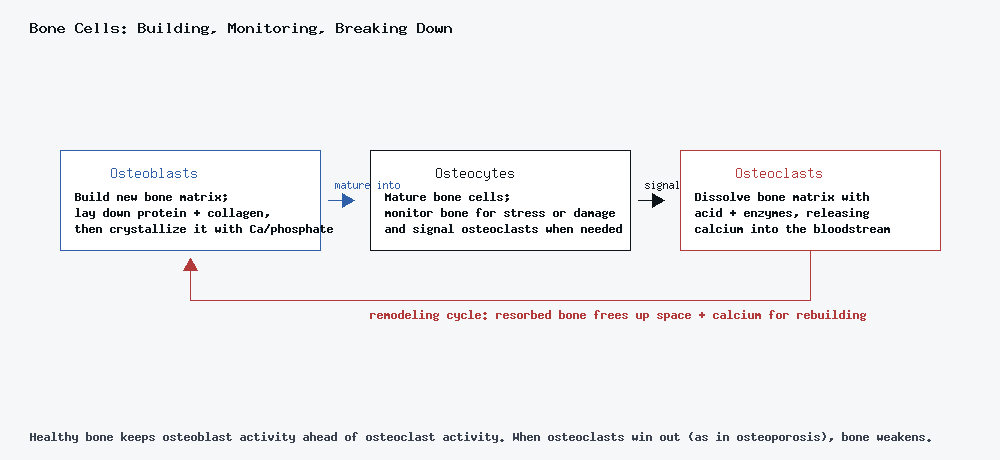
- Osteoblasts — drive bone growth and formation. They lay down osteoid (protein and collagen fibers), then crystallize it with calcium and phosphate to harden it into bone matrix.
- Osteoclasts — dissolve bone matrix using acid (HCl) and enzymes, releasing calcium into the bloodstream in the process.
- Osteocytes — mature bone cells that monitor bone for stress or damage, and signal osteoclasts into action when repair or remodeling is needed.
Clinical Conditions
Osteoporosis
Happens when osteoclast activity outpaces osteoblast activity, leaving bones progressively weaker. Normally osteoblast activity should stay ahead of osteoclast activity; osteoporosis is common in women after menopause, when a drop in estrogen removes some of the normal brake on osteoclasts.
Osteogenesis Imperfecta
Caused by reduced collagen production, leading to brittle bones. If the mineral matrix is still there but the collagen/protein fibers are missing, the bone loses its flexibility — it has no give left to absorb force before it snaps.
Rickets
Caused by a vitamin D₃ deficiency, leading to softer bones. Low blood calcium availability means osteoblasts have less calcium to work with during bone formation, so the resulting matrix ends up softer than it should be.
Hormonal Processes
Sex hormones (estrogen, testosterone, and progesterone) stimulate osteoblast activity, driving bone growth.
Calcitonin becomes active when blood calcium is high, and works by inhibiting osteoclast activity — it slows bone breakdown so less calcium is released.
Calcitriol is the active form of vitamin D₃ in the body. At normal blood calcium levels, it tells the small intestine to absorb more dietary calcium and tells the kidneys to reabsorb calcium that would otherwise be lost in urine. It also signals the parathyroid gland to stop producing PTH once calcium is back to normal.
Parathyroid hormone (PTH) is released when blood calcium is low. It signals osteoclasts to break down bone matrix and release calcium into the blood, and at low calcium levels it works synergistically with calcitriol to also pull more calcium in from the small intestine and kidneys.
Putting the loop together: low blood calcium → PTH released → kidneys release stored calcitriol → calcitriol increases intestinal and kidney calcium absorption → PTH also triggers osteoclasts to free up calcium from bone → blood calcium rises back to normal → calcitriol tells the parathyroid gland to stop making PTH.