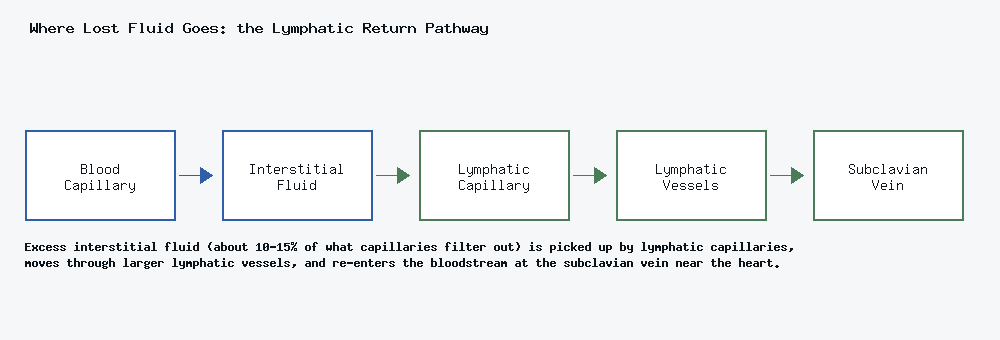
The lymphatic system’s primary job is managing interstitial fluid — the fluid that surrounds your cells. As blood moves through capillaries, some fluid always leaks out into the surrounding tissue. The lymphatic system collects that lost fluid and eventually returns it to the bloodstream, keeping fluid volume balanced throughout the body.
Capillaries
Capillaries are the smallest blood vessels in the body, and the only ones that directly interact with peripheral tissue — arteries and veins are just the highways that get blood to and from them. Each capillary has an arterial side and a venous side, with tiny holes (fenestrations) in its walls. Fluid carrying proteins and nutrients passes through these holes into the tissue, while the remaining fluid keeps moving through the capillary back toward the heart.
Capillary walls are only a single cell thick, which is exactly what makes this exchange possible — it’s thin enough for fluid, gases, and small molecules to pass through easily.
Pressure and Fluid Balance
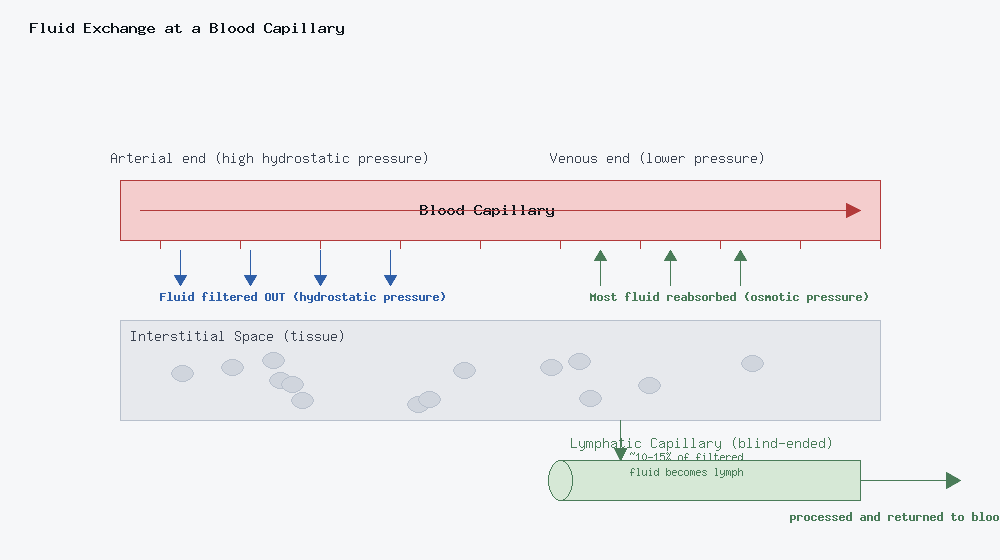
The lymphatic system is governed by two competing pressure gradients: hydrostatic pressure and osmotic pressure. At any given capillary, not all of the fluid that gets filtered out is reabsorbed — roughly 10–15% of it stays behind in the interstitial space. That leftover fluid is what becomes lymph.
Hydrostatic Pressure
Hydrostatic pressure is pressure generated by the heart’s pumping action. Since fluid moves from high pressure to low pressure, this pressure pushes fluid from the arterial end of the capillary toward the venous end, where pressure is lower. Along the way, that same pressure forces some fluid out through the capillary’s tiny pores and into the interstitial space — most of it near the arterial end, where pressure is highest. The lymphatic system’s job is to pick up whatever fluid gets pushed out this way, process it, and return it to the bloodstream.
Osmotic Pressure
Blood plasma contains more dissolved proteins than the interstitial fluid does, and osmotic pressure pulls fluid toward the side with a higher solute concentration — in this case, back into the plasma. This osmotic pull is what draws most of the filtered fluid back into the capillary as it nears the venous end. The lymphatic system removes whatever fluid osmotic pressure doesn’t manage to pull back in.
In short: hydrostatic pressure pushes fluid out at the arterial end, osmotic pressure pulls most of it back in at the venous end, and the lymphatic system quietly cleans up the small amount left over — without it, fluid would steadily build up in the tissues (a condition called edema).