
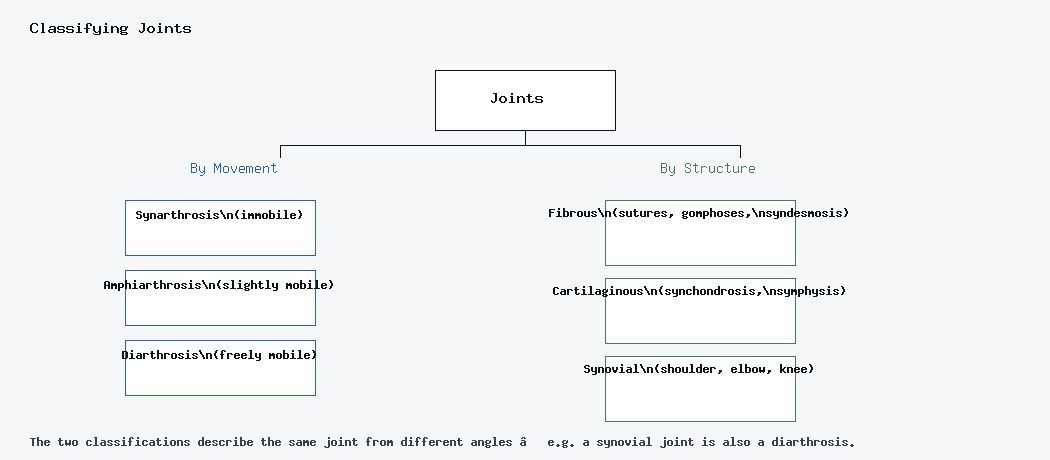
A joint (or articulation) is any point where two bones meet. Joints can be classified two ways — by how much they move, and by what they’re structurally made of — and the two classifications describe the same joint from different angles.
Classifications
By Movement
- Synarthrosis — immobile.
- Amphiarthrosis — slightly mobile, slightly stable.
- Diarthrosis — freely mobile.
By Structure
- Fibrous joints — made of fibrous connective tissue. Includes sutures, gomphoses, and syndesmosis.
- Cartilaginous joints — made of cartilage. Synchondrosis is immobile; symphysis is slightly mobile (this is what holds the pelvis together).
- Synovial joints — also called diarthrosis joints; freely mobile. Examples include the shoulder, elbow, and knee.
Joint Composition
A synovial joint’s articular capsule has two layers: an outer fibrous layer for protection, and an inner synovial membrane that produces synovial fluid to lubricate the joint. Surrounding structures include tendons (connecting muscle to bone), ligaments (connecting bone to bone), and cushioning structures like bursae and tendon sheaths.
Joint Movements
- Pronation — palm facing downward.
- Supination — palm facing upward.
- Flexion and extension — bending and straightening a joint.
Synovial Joint Examples
- Vertebrae — connected by a mix of fibrocartilaginous and synovial joints.
- Knee — the femur articulates with the tibia and the patella — notably, not the fibula.
- Herniated disc — occurs when the nucleus pulposus pushes through a damaged annulus fibrosus (fibrocartilage).
A useful exam habit: for any joint you’re asked about, first ask whether it’s synovial or not — that single distinction usually settles both classification questions at once.