
The urinary system is made up of the kidneys, ureters, urinary bladder, and urethra. Its real work happens inside the kidneys, where several essential processes convert filtered blood plasma into urine.
Core Functions of the Kidneys
Elimination of Metabolic Wastes
The kidneys remove waste products like urea and uric acid from the filtrate before they can build up to toxic levels in the blood.
Regulation of Ion Levels
The kidneys keep blood ion levels — sodium, potassium, calcium, and phosphate — in balance by adjusting how much of each is excreted, depending on dietary intake.
Regulation of Acid-Base Balance
By varying how much hydrogen and bicarbonate ion is excreted in urine, the kidneys help hold blood pH steady.
Regulation of Blood Pressure
The kidneys help set blood pressure by controlling how much fluid is excreted in urine, which directly affects blood volume. They also release renin, an enzyme required to produce angiotensin II — a hormone that raises blood pressure. This is considered one of the kidneys’ most important functions.
The Nephron: The Kidney’s Filtration Unit
The nephron is the kidney’s functional filtration unit. It splits into two main parts: the renal corpuscle, where filtration happens, and the renal tubule, where the filtrate is processed into urine.
Renal Corpuscle (Filtration)
The renal corpuscle is made of the glomerulus (a network of capillaries) surrounded by the glomerular (Bowman’s) capsule. Blood enters through the afferent arteriole and exits through the efferent arteriole. The glomerulus filters the blood into filtrate — water, ions, glucose, and waste products all pass through, while large proteins and blood cells stay behind in the blood.
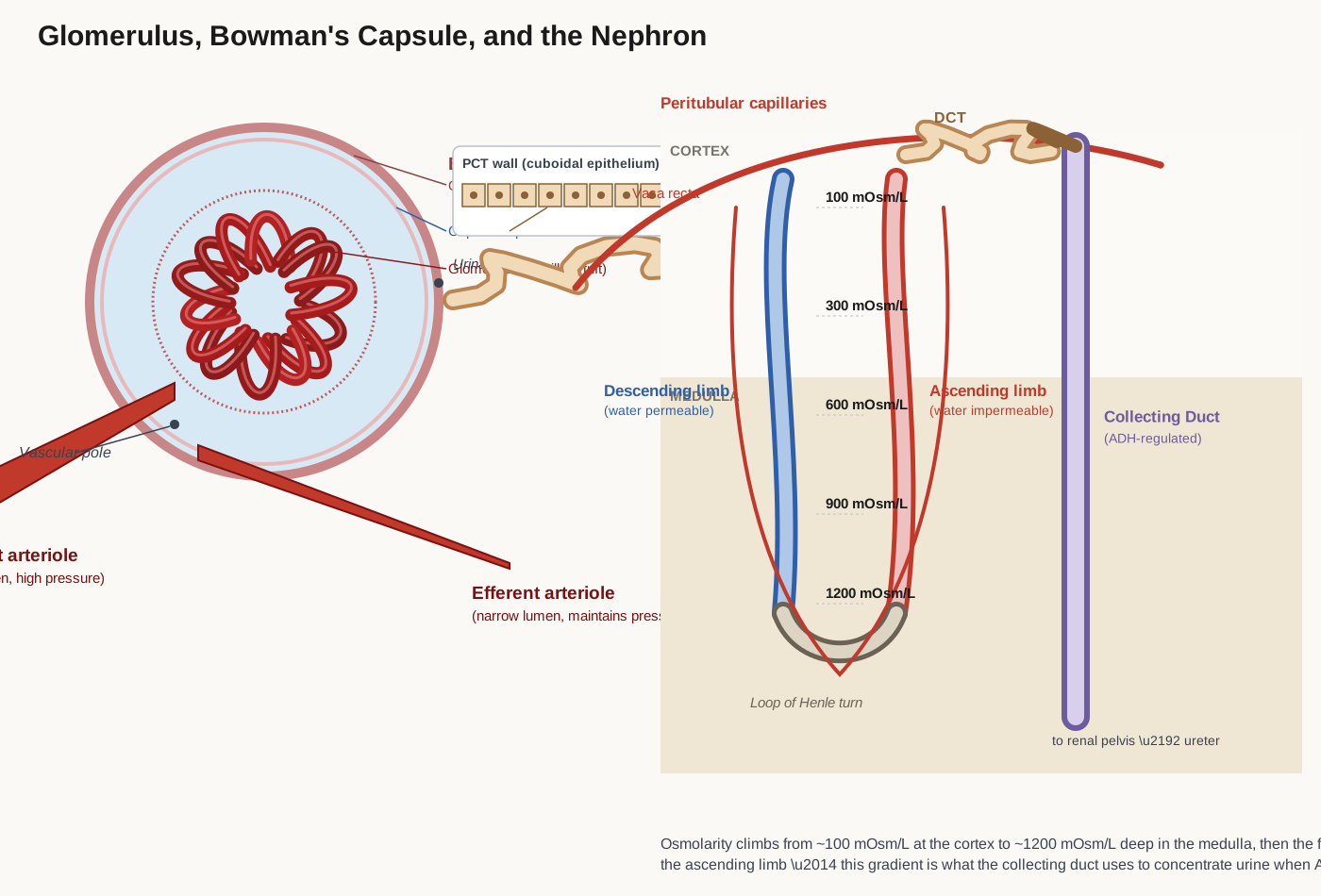
Original illustration, built for this site — no external license required.
Renal Tubule: Processing the Filtrate
Proximal Convoluted Tubule (PCT)
The PCT reabsorbs the bulk of the filtrate — roughly 65–70% — including sodium (Na+), chloride (Cl-), glucose, amino acids, and water. Almost none of this is hormonally regulated; it happens no matter what the body needs at the moment.
Nephron Loop (Loop of Henle)
The loop of Henle’s job is counter-current multiplication — building the steep osmotic pressure gradient deep in the medulla that the rest of the kidney depends on to concentrate urine.
- Descending limb — permeable to water, impermeable to solutes. Water leaves the tubule and the filtrate becomes progressively more concentrated as it descends.
- Ascending limb — impermeable to water. Solutes are actively pumped out into the medullary interstitial fluid, which dilutes the filtrate and makes the surrounding medulla increasingly salty.
By the time filtrate reaches the top of the ascending limb it’s back down to roughly 100 mOsm — far more dilute than the ~1200 mOsm found deep in the renal medulla. That gradient isn’t wasted: later, when ADH inserts aquaporin channels into the collecting duct, this steep concentration difference is exactly what pulls water rapidly out of the dilute filtrate and back into the body.
Distal Convoluted Tubule (DCT)
The DCT fine-tunes electrolyte balance, and unlike the PCT, its work is hormonally regulated. Aldosterone drives sodium reabsorption and potassium excretion here (though the filtrate is still fairly dilute at this point), and parathyroid hormone drives calcium reabsorption.
Collecting Duct
The collecting duct has final control over water balance, regulated by antidiuretic hormone (ADH).
- ADH present — aquaporin channels are inserted into the collecting duct, water permeability increases, and water moves out of the tubule into the salty medulla. The result is concentrated urine.
- ADH absent — no aquaporins, no water reabsorption. Water stays in the tubule, producing dilute urine.
This is the last checkpoint in the nephron, so it’s what ultimately determines final urine concentration.
Reabsorption by Tubule Segment
Segment | Water Reabsorption | Water Regulated | Sodium Reabsorption | Sodium Regulated
- Proximal Convoluted Tubule — Water: yes (non-regulated). Sodium: yes (non-regulated).
- Thick Ascending Limb — Water: no. Sodium: yes (non-regulated).
- Distal Convoluted Tubule — Water: yes (regulated). Sodium: yes (regulated).
- Collecting Duct — Water: yes (regulated). Sodium: yes (regulated).
Notice the pattern: the PCT and the thick ascending limb do their reabsorption automatically, with no hormonal input, while the DCT and collecting duct are where the body fine-tunes things based on hormones like aldosterone and ADH.
Nervous System Regulation
The autonomic nervous system connects directly to the blood vessels of the kidney. Sympathetic stimulation (the fight-or-flight response) decreases glomerular filtration and urine production — in an emergency, the body prioritizes maintaining blood pressure over filtering blood.
The afferent arteriole carries blood into the glomerulus. It’s wider than the efferent arteriole, which allows high-pressure filtration, and it responds rapidly to pressure changes through the myogenic response. The efferent arteriole carries filtered blood away from the glomerulus to the peritubular capillaries; its narrower diameter is what maintains high pressure upstream in the afferent arteriole, and it’s heavily regulated by vasoconstrictors like angiotensin II to keep filtration going even when overall blood flow to the kidney is low.
- Afferent arteriole dilates → resistance decreases → more blood fills the glomerulus → glomerular hydrostatic pressure rises → filtration rate increases.
- Afferent arteriole constricts → resistance increases → less blood fills the glomerulus → glomerular hydrostatic pressure falls → filtration rate decreases.
This is why afferent arteriole diameter is such a direct lever on filtration rate: it changes how much blood — and therefore how much pressure — builds up in the glomerulus before it can drain out through the narrower efferent arteriole.