
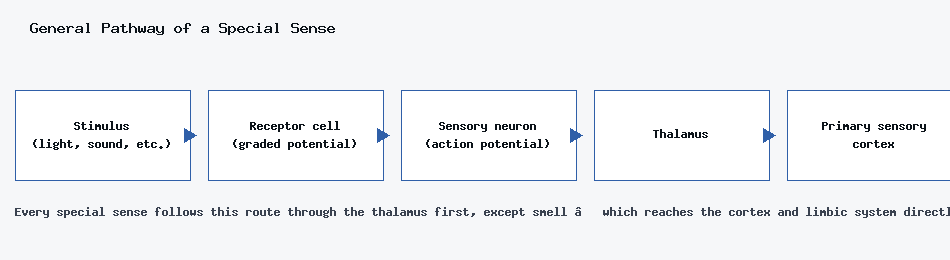
The special senses — taste, smell, vision, hearing, and balance — all follow the same basic logic: a stimulus changes a receptor cell’s membrane potential, that graded change eventually triggers an action potential, and the signal travels to the brain to be interpreted.
Taste (Gustation)
Dissolved chemicals from food bind to gustatory epithelial cells, changing their membrane potential and creating a graded potential. Once that graded potential is strong enough, it activates the connected sensory neuron, which fires an action potential toward the brain.
Smell (Olfaction)
Airborne molecules bind to olfactory receptors in the nasal cavity, again changing the receptor cell’s membrane potential and generating an action potential. These signals travel through the cribriform plate of the ethmoid bone to the olfactory bulb, and from there to both the primary olfactory cortex and the limbic system — which is exactly why smell is so strongly tied to memory and emotion.
Vision
Eye Anatomy
- Cornea — bends incoming light.
- Lens — changes shape to focus the image.
- Iris — regulates how much light enters.
- Retina — contains the photoreceptors: rods and cones.
Rods are highly sensitive and detect dim light; cones detect color and provide sharp vision, concentrated especially in the fovea.
Visual Pathway
Incoming light activates photoreceptors, which respond to photons with an electrical change that activates retinal neurons. The signal eventually reaches the optic nerve, which carries it to the thalamus and then to the primary visual cortex in the occipital lobe.
Hearing and Balance
Sound is a mechanical vibration moving through the air into the ear canal. Those vibrations move the tympanic membrane and the tiny ossicles, which in turn stimulate hair cells inside the cochlea.
Balance works on the same hair-cell principle: the semicircular canals detect head rotation, while the vestibule (utricle and saccule) detects linear acceleration. Both rely on hair cells responding to fluid movement within these structures.
One rule ties all of this together: every special sense except smell sends its signal to the thalamus before reaching the cortex.
A Closer Look at Graded Potentials
Every one of the senses above starts with a graded potential, so it’s worth being precise about what that means at the membrane level:
- EPSP (Excitatory Postsynaptic Potential) — sodium flows into the cell, raising intracellular charge and increasing the likelihood of an action potential. This is depolarization.
- IPSP (Inhibitory Postsynaptic Potential) — potassium leaves the cell, making it more negative and decreasing the likelihood of an action potential. This is hyperpolarization.
Whether a given sense ends up firing an action potential comes down to whether enough EPSPs outweigh any IPSPs to cross threshold — the same summation logic that governs every neuron in the body, sensory or otherwise.