The nervous system runs on electricity and chemistry — tiny voltage changes across a neuron’s membrane that, once they cross a threshold, become an all-or-nothing signal traveling the length of the cell.
Go Deeper
This page covers the fundamentals. For a full breakdown of each subsystem, start here:
General Organization
- Central Nervous System (CNS) — brain and spinal cord.
- Peripheral Nervous System (PNS) — cranial and spinal nerves.
- Autonomic Nervous System (ANS) — splits into the sympathetic division (fight or flight) and the parasympathetic division (rest and digest).
- Afferent neurons carry sensory information toward the CNS; efferent neurons carry motor commands out to muscles and glands.
Resting Membrane Potential
A resting neuron sits at roughly -70 mV — closer to potassium’s (K⁺) equilibrium potential than sodium’s. This is maintained by the Na⁺/K⁺ ATPase pump, which pumps 3 Na⁺ out for every 2 K⁺ it brings in, creating a net negative charge inside the cell. The membrane is also more permeable to K⁺ than Na⁺ at rest, which is what keeps the inside negative even between pump cycles.
Common exam trap: if only Na⁺ channels were open, resting potential would swing to roughly +55 mV. If only K⁺ channels were open, it would settle around -90 mV. The actual resting value of -70 mV sits in between, reflecting that the membrane leans toward K⁺ permeability but isn’t exclusively permeable to it.
Graded vs. Action Potentials
A graded potential is a small, localized change that fades with distance. It can be depolarizing or hyperpolarizing, occurs in the dendrites or cell body, and results from chemically-gated channels opening temporarily to let ions cross the membrane.
An action potential is different in almost every way: it’s an all-or-none, traveling signal generated at the axon hillock. It starts only once voltage-gated channels open in response to the minimum threshold being reached — as long as that threshold is met, the action potential fires at full strength; if it isn’t met, nothing happens at all. Action potentials are always depolarizing.
Action Potential Phases
- Depolarization — Na⁺ channels open, Na⁺ rushes in, and the inside of the cell becomes more positive.
- Repolarization — K⁺ channels open, K⁺ rushes out, and the inside becomes more negative again.
- Hyperpolarization — slightly too much K⁺ leaves, briefly overshooting past resting potential, until the Na⁺/K⁺ pump restores the baseline.
Refractory Periods
During the absolute refractory period, Na⁺ channels are inactivated and no new action potential is possible, no matter how strong the stimulus. During the relative refractory period, K⁺ channels are still open, so a new action potential is possible — it just takes a stronger-than-usual stimulus to trigger one.
This is also why an action potential only ever travels one direction down the axon: the region just behind the traveling wave still has its Na⁺ channels inactivated from the refractory period, so the signal can’t double back on itself — it can only move forward into fresh, un-fired membrane.
Toxins
- Blocked Na⁺ channels — no action potential can fire, leading to flaccid paralysis.
- Blocked K⁺ channels — K⁺ can’t leave the cell, which delays repolarization.
- Tetanus toxin — prevents Na⁺ channel inactivation, so Na⁺ channels stay open and the neuron fires continuously; this sustained firing is where the condition tetanus gets its name (sustained muscle contraction).
Reflex Example: The Knee Jerk
Tapping the patellar tendon stretches the quadriceps, which activates sensory neurons. Those neurons excite motor neurons to the knee extensors while simultaneously inhibiting the flexors, whose antagonist neurons hyperpolarize — producing the classic kick.
Flow of a Neural Signal
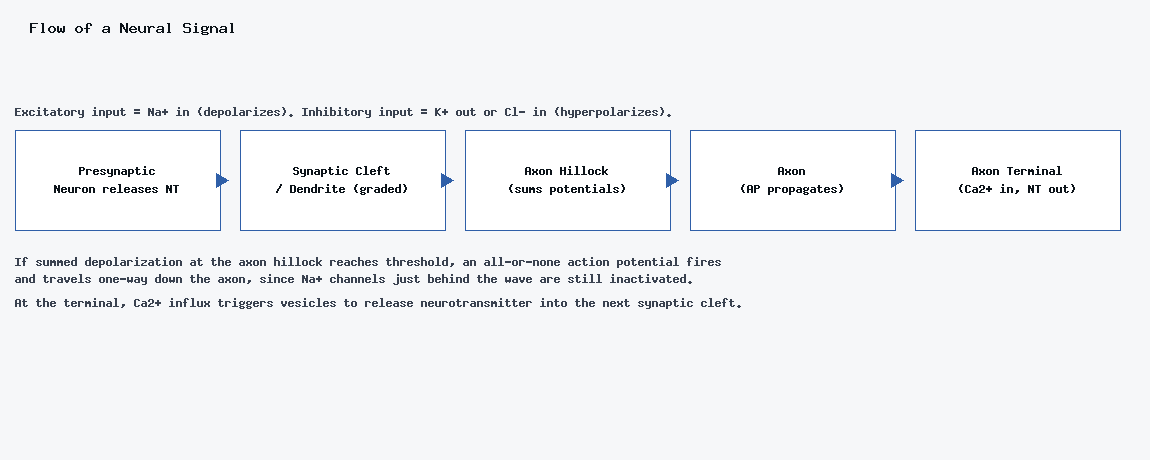
- The presynaptic neuron releases neurotransmitter (e.g. ACh) into the synaptic cleft, where it connects to the dendrites of the next neuron.
- Neurotransmitter binds chemically-gated ion channels on the dendrites or soma of the postsynaptic neuron, producing a graded potential.
- The axon hillock sums all incoming graded potentials — excitatory ones (Na⁺ in, depolarizing) and inhibitory ones (K⁺ out or Cl⁻ in, hyperpolarizing). If the summed depolarization reaches threshold, voltage-gated Na⁺ channels open.
- The local depolarization spreads down the axon: voltage-gated Na⁺ channels open and depolarize each section in turn, then voltage-gated K⁺ channels open shortly after and repolarize that same section back toward -70 mV — while the section ahead is depolarizing.
- At the axon terminal, the arriving depolarization opens voltage-gated Ca²⁺ channels. Ca²⁺ enters, triggering neurotransmitter-filled synaptic vesicles to fuse with the membrane and release their contents into the next synaptic cleft — and the whole process starts again in the next neuron.